
What is a MYGA?
How Multi-Year Guaranteed Annuities Work
A multi-year guaranteed annuity, or MYGA, is a type of fixed deferred annuity that generally provides a guaranteed interest rate for a specified period. You place money with an insurance company, and the contract earns interest according to its stated terms without direct exposure to stock-market gains or losses.
In exchange for that predictability, access to the money may be restricted during the contract’s surrender period.
A MYGA may be appropriate for someone who wants to help protect a portion of retirement savings from market volatility and know in advance how the contract is designed to grow. But the interest rate is only one part of the contract. It is equally important to understand the guarantee period, surrender charges, withdrawal provisions, market value adjustment, tax treatment, and end-of-term options.
MYGA Key takeaways
- MYGA stands for multi-year guaranteed annuity.
- A MYGA is an insurance contract, not a bank account or stock-market investment.
- A traditional MYGA generally guarantees an interest rate for a stated number of years.
- The contract value is not reduced solely because the stock market declines.
- Earnings in a nonqualified MYGA generally accumulate tax-deferred.
- Withdrawals, in excess of any available free withdrawal amount, may be subject to surrender charges and a market value adjustment.
- The amount available upon surrender may differ from the stated contract value.
- At the end of the guarantee period, the owner may need to select a renewal or withdrawal option.
- MYGAs are not insured by the FDIC.
- All guarantees depend on the claims-paying ability of the issuing insurance company.
The National Association of Insurance Commissioners describes fixed deferred annuities as long-term insurance contracts that accumulate value before income begins. Product guarantees, charges, withdrawal rights, and payout options vary by contract.

What does MYGA stand for?
MYGA stands for multi-year guaranteed annuity.
A MYGA is generally a type of fixed deferred annuity. “Fixed” refers to the contractual interest guarantee. “Deferred” means that income payments do not have to begin immediately. “Multi-year guaranteed” refers to the period during which the contract’s stated interest-crediting terms apply.
A traditional MYGA is usually purchased with a single premium, although the funding rules depend on the specific product.
The owner is not purchasing stocks, bonds, mutual funds, or shares of a market index. The premium becomes part of an insurance contract issued by a life insurance company.
How does a traditional MYGA work?
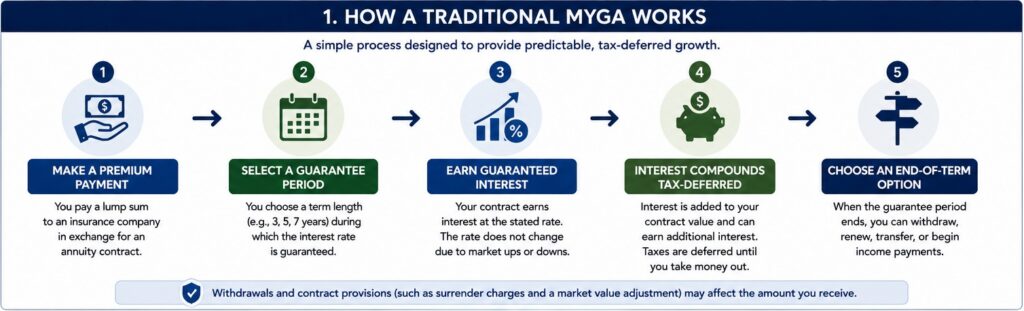
Although contract designs vary, a traditional MYGA generally follows five steps.
1. You make a premium payment
You transfer money to the issuing insurance company in exchange for the annuity contract.
The contract may accept:
- Nonqualified money, such as funds from a savings or brokerage account
- Qualified retirement money from an IRA or another eligible retirement arrangement
- Money transferred from another annuity through an eligible exchange
- Funds from another source permitted by the contract
The tax treatment and transfer requirements can differ depending on where the money comes from.
2. You select a guarantee period
The guarantee period is the length of time covered by the contract’s stated interest guarantee.
MYGAs may be available with different term lengths. The available choices vary by insurer and product.
A shorter period provides an earlier opportunity to reconsider available rates or use the money. A longer period provides rate certainty for more years but generally requires a longer commitment.
3. The contract earns interest
A traditional MYGA credits interest at the rate specified for the selected guarantee period.
The return may be expressed as an annual effective yield. Interest is generally added to the contract value and can then earn additional interest.
During the applicable guarantee period, the credited rate does not change because:
- The stock market rises or falls
- A market index performs positively or negatively
- The owner’s selected investments change
The owner does not select investments within a traditional MYGA.
4. Interest accumulates tax-deferred
For a nonqualified annuity, federal income tax is generally deferred while interest remains in the contract.
That allows the full contract value—including previously credited interest—to continue earning potential interest until money is distributed.
Tax deferral does not mean that the earnings are tax-free. Taxable amounts are generally recognized when money is withdrawn or paid from the annuity. The rules depend on the account type and form of distribution.
5. You make a decision when the guarantee period ends
Depending on the contract, the owner may be able to:
- Withdraw the contract value
- Select another available guarantee period
- Accept a renewal rate
- Transfer the value to another eligible annuity
- Begin scheduled income payments
- Leave the contract under a continuation provision
The available choices, decision window, new interest rate, and possibility of a new surrender period are controlled by the contract.
A simple MYGA example
Suppose someone purchases a five-year traditional MYGA with a premium of $100,000 and a guaranteed annual effective yield of 5%.
Assuming no withdrawals, charges, or distributions, the hypothetical value would grow as follows:
| End of year | Hypothetical contract value |
| Initial premium | $100,000 |
| Year 1 | $105,000 |
| Year 2 | $110,250 |
| Year 3 | $115,763 |
| Year 4 | $121,551 |
| Year 5 | $127,628 |
This hypothetical example assumes the guaranteed rate remains in effect for the full guarantee period and that no withdrawals or other transactions occur. The value is predictable because the hypothetical rate is fixed for the entire five-year period.
This example is for educational purposes only. It does not represent a current Oceanview rate, a particular product, or the amount available following a withdrawal or surrender. Actual values depend on the applicable rate, contract terms, timing, taxes, and transactions.
Important MYGA terms to understand
Premium
The amount paid to purchase the annuity.
A MYGA is often described as a single-premium deferred annuity because many contracts are funded with one initial payment.
Guarantee period
The period during which the stated interest-crediting terms apply.
A five-year guarantee period, for example, generally means that the applicable rate is established under the contract for five years. Review the contract carefully because not every product marketed as a MYGA uses the same rate structure.
Guaranteed interest rate
The contractual rate used to credit interest during the applicable period.
Ask whether the quoted figure is:
- An annual effective yield
- A simple interest rate
- A first-year rate
- A rate guaranteed for the entire term
- A rate that resets under a contractual formula
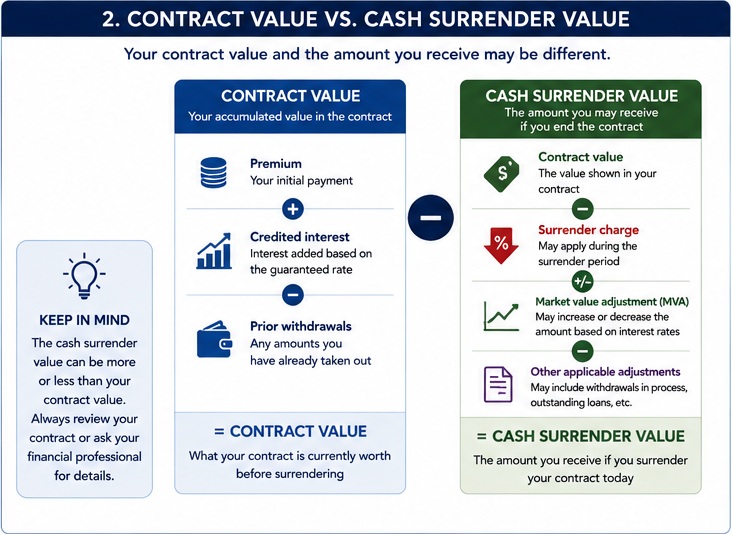
Contract value
The accumulated premium and credited interest, adjusted for any withdrawals and other applicable contract provisions.
Cash surrender value
The amount available if the entire contract is surrendered.
Cash surrender value may differ from contract value because surrender charges, a market value adjustment, prior withdrawals, or other provisions may apply.
Surrender period
The period during which withdrawing more than the permitted amount may result in a surrender charge.
The surrender period and interest-rate guarantee period should both be reviewed. Do not assume that they are identical simply because they have the same stated number of years.
Free-withdrawal provision
The amount the contract permits the owner to withdraw without a surrender charge.
The provision may be based on:
- Initial premium
- Contract value
- A percentage determined on the contract anniversary
- Another formula described in the contract
A free withdrawal may still have tax consequences or reduce future contract benefits.
Market value adjustment
A market value adjustment, or MVA, is a contract provision that may increase or decrease the amount received from certain withdrawals or a full surrender.
The effect generally depends on how market interest rates have changed since the annuity was issued, although the specific formula varies by contract. The NAIC advises owners to review the contract because an MVA may affect contract value, surrender value, or death-benefit value.
Maturity or renewal date
The date on which the guarantee period ends, and the contract enters its next phase.
The owner may have a limited window in which to select a new term, withdraw the value, or choose another available option.
Is a MYGA rate guaranteed?
For products that provide a level guaranteed rate, the applicable interest rate is contractually guaranteed for the selected guarantee period.
However, consumers should verify exactly what the guarantee covers.
Ask:
- Is one rate guaranteed for the full term?
- Is the rate an annual effective yield?
- Does the rate apply to the full premium?
- Are there different rates for different premium amounts?
- Is any portion of the quoted rate introductory?
- Does the rate reset at any point?
- What rate applies after the initial guarantee period?
- What minimum renewal rate is stated in the contract?
Not every MYGA uses the same rate structure
The term MYGA is commonly associated with one fixed rate guaranteed for multiple years. Some products use a different contractual approach.
For example, Oceanview’s CurrentRate® MYGA is designed with a first-year rate followed by annual rate resets under a stated formula tied to the one-year U.S. Treasury rate plus a guaranteed spread. That makes reading the specific contract essential rather than assuming every product functions like a traditional level-rate MYGA.
The clearest question is not merely:
What is today’s rate?
It is:
How will interest be determined during every year that I expect to own this contract?
How does interest compound in a MYGA?
When interest is credited and left in the annuity, it generally becomes part of the contract value. Future interest can then be calculated on both:
- The original premium
- Previously credited interest
This is compound growth.
For example, at a hypothetical 5% annual effective yield:
- $100,000 earns $5,000 during the first year.
- The next year begins with $105,000.
- A 5% credit on $105,000 equals $5,250.
- The contract would then have a hypothetical value of $110,250.
Withdrawals reduce the value available to earn future interest.
Can the MYGA value decline?
A MYGA is not directly exposed to stock-market declines. If the stock market falls, the contract value does not fall merely because of that market movement.
However, the amount the owner receives can be reduced by:
- Surrender charges
- A negative market value adjustment
- Partial withdrawals
- Taxes
- An additional federal tax on some early distributions
- Contract provisions affecting death or income benefits
The financial condition of the issuing insurer, as guarantees are subject to the insurer’s claims-paying ability This is why contract value and cash surrender value should not be treated as interchangeable.
The NAIC notes that surrender charges commonly decline over time and that many contracts allow a limited annual withdrawal without a surrender charge. The exact allowance, waivers, and calculations must be confirmed in the contract.
How do MYGA withdrawals work?
Most MYGAs allow the owner to request partial or full withdrawals. The financial consequences depend on:
- The year of the contract
- The amount withdrawn
- The free-withdrawal allowance
- The surrender schedule
- Whether an MVA applies
- The source of the premium
- The owner’s age
- The contract’s tax status
Partial withdrawal
A partial withdrawal removes only part of the contract value.
An amount within the contract’s free-withdrawal allowance may avoid a surrender charge. It can still reduce future interest and may create taxable income.
Full surrender
A full surrender terminates the annuity and pays the applicable cash surrender value.
If the surrender occurs during the surrender period, the amount may be reduced by a surrender charge and MVA. Once the contract is surrendered, its future guarantees and income rights end.
Surrender Charge Waiver withdrawals
Some contracts waive surrender charges following specific qualifying events, which may include terminal illness or nursing-home confinement.
The eligibility definitions, waiting periods, required documentation, state availability, and MVA treatment vary. A waiver should not be described as automatic access without reviewing its conditions.
How is a MYGA taxed?
Tax treatment depends on whether the MYGA is qualified or nonqualified and on how money is distributed.
Nonqualified MYGA
A nonqualified MYGA is generally funded with money that has already been subject to income tax.
Interest usually accumulates tax-deferred while it remains inside the contract.
Before annuity payments begin, a partial nonperiodic withdrawal from a nonqualified commercial annuity is generally allocated first to earnings—the taxable portion—and then to the owner’s investment in the contract.
Qualified MYGA
A qualified MYGA is held within an IRA or another eligible tax-qualified arrangement.
The account already provides tax-deferred treatment. The annuity does not create an additional tax-deferral benefit, although it may provide contractual interest guarantees, withdrawal provisions, or income options.
Tax rules for qualified accounts differ from the rules for nonqualified annuities.
Early distributions
The taxable portion of many distributions made before age 59½ may be subject to an additional 10% federal tax unless an exception applies.
Income payments
The taxation of periodic annuity payments depends on factors including:
- Qualified or nonqualified status
- The owner’s investment in the contract
- The payout option
- The annuity starting date
- Life expectancy calculations
- Whether the payment continues to a beneficiary
Consult a qualified tax professional about individual circumstances.
What happens when a MYGA term ends?
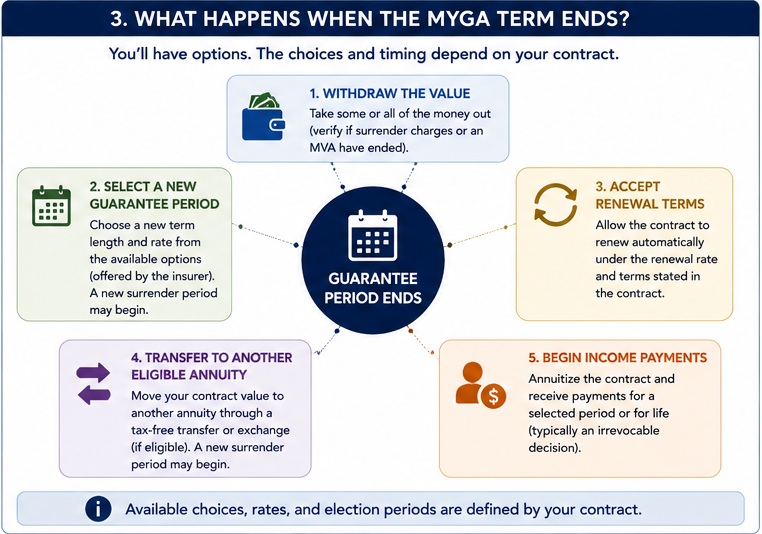
The end of the guarantee period is an important decision point—not simply an administrative date.
The insurance company may provide a notice explaining the available options and the time allowed to make a selection.
Possible choices may include:
Withdraw the value
The owner may be able to withdraw some or all of the applicable value during a contractually defined window.
Confirm whether surrender charges and the MVA have ended.
Select a new guarantee period
The insurer may offer a choice of new guarantee terms and rates.
Selecting a new term may begin a new surrender period.
Accept an automatic renewal
If no election is made, the contract may automatically renew under a term or rate described in the contract.
The automatic option may not be the one the owner would have selected after comparing the available choices.
Transfer the value
An owner may be able to complete an eligible transfer or exchange to another annuity.
Tax and replacement rules can be complex. The new product may also begin a new surrender period.
Begin income
The owner may be able to annuitize the contract or select another available income option.
Annuitization can create guaranteed payments for a specified period or for life, depending on the settlement option. It may also be irrevocable and end access to the remaining contract value. The NAIC notes that payout rights and survivor payments depend on the selected option.
MYGA vs. fixed annuity
A MYGA is a type of fixed annuity.
“Fixed annuity” is the broader category. It includes contracts that credit interest according to terms established by the insurer.
A MYGA is generally distinguished by having an interest guarantee that extends for multiple years.
| Term | Meaning |
| Fixed annuity | Broad category of annuity with fixed-interest guarantees |
| Deferred annuity | Accumulates value before income payments begin |
| MYGA | A fixed deferred annuity with multi-year interest-crediting terms |
| SPIA | A single-premium immediate annuity designed to begin income soon after purchase |
| FIA | A fixed indexed annuity with interest based partly on index performance |
MYGA vs. certificate of deposit
MYGAs and bank CDs can both offer a stated rate for a defined period, but they are different financial products.
| Feature | MYGA | Bank CD |
| Issuer | Insurance company | Bank or credit union |
| Product type | Insurance contract | Deposit account |
| Interest | Determined under the annuity contract | Determined under the deposit agreement |
| Tax treatment outside a qualified account | Generally, tax-deferred until distribution | Interest is generally taxable as earned |
| Early access | May involve surrender charges and an MVA | May involve an early-withdrawal penalty |
| FDIC insurance | No | Generally, yes when held at an FDIC-insured bank within applicable limits |
| Guarantee | Issuing insurer’s claims-paying ability | Issuing bank and applicable deposit insurance |
| Income options | May include annuity settlement options | Generally, does not provide annuity income options |
The FDIC identifies annuities as non-deposit products that are not insured by the FDIC, even when sold at an insured bank. A bank certificate of deposit and a MYGA are different financial products and should not be compared solely based on stated interest rates.
MYGA vs. fixed indexed annuity
Both products are insurance contracts and can protect contract value from direct stock-market declines. They calculate interest differently.
| Feature | Traditional MYGA | Fixed indexed annuity |
| How interest is determined | Guaranteed fixed rate for a stated period | Based partly on the performance of a market index |
| Is the return known in advance? | Generally, yes during the guaranteed term | No |
| Direct market investment | No | No |
| Market upside | No participation beyond the contractual rate | Limited index-linked potential |
| Crediting limits | Contractual fixed rate | May include caps, participation rates, or spreads |
| Primary appeal | Certainty and predictability | Protection with some index-linked potential |
| Primary tradeoff | No market upside and limited liquidity | Limited index participation and more complex mechanics |
Someone primarily seeking a known result may prefer the predictability of a traditional MYGA. Someone willing to accept an unknown result for potential index-linked interest may wish to learn more about an FIA.
What are the potential benefits of a MYGA?
Predictable growth
A traditional MYGA allows the owner to calculate the expected contract value in advance when the stated rate applies for the full term.
Protection from direct market losses
The contract does not lose value simply because the stock market declines.
Tax-deferred accumulation
Interest can remain in a nonqualified contract without annual taxation until a distribution occurs.
Simple mechanics
A traditional MYGA generally does not require the owner to choose investments, indexes, caps, or participation rates.
Different term options
Available guarantee periods can allow the owner to align the contract with a future retirement date or financial objective.
Potential income options
The owner may later have the option to convert contract value into periodic income.
Death-benefit provisions
Many contracts provide a value for named beneficiaries if the owner or annuitant dies before income begins. The amount and payment rules vary.
What are the principal tradeoffs?
Limited liquidity
The money may be subject to surrender charges for several years.
Market value adjustment risk
Certain withdrawals may be increased or decreased by an MVA.
No stock-market upside
A traditional MYGA earns its contractual interest rather than participating in market gains.
Inflation risk
A fixed nominal return may not keep pace with increasing living costs.
Interest-rate opportunity risk
New products may offer higher rates after the MYGA has been purchased.
Taxation as ordinary income
Taxable annuity earnings are generally not taxed at capital-gains rates.
Insurer risk
Contractual guarantees depend on the issuing insurance company rather than federal deposit insurance.
For a more complete evaluation, read MYGA Pros and Cons: What to Consider Before You Buy.
Who might consider a MYGA?
A MYGA may be worth discussing with a licensed financial professional when someone:
- Wants a portion of retirement assets protected from direct market volatility
- Values a return that can be calculated in advance
- Can leave the money in the contract through the intended term
- Has adequate emergency and short-term savings elsewhere
- Wants tax-deferred accumulation in a nonqualified account
- Prefers straightforward contract mechanics
- Understands the surrender-charge and MVA provisions
- Is comfortable relying on the issuing insurer’s claims-paying ability
When might a MYGA be less appropriate?
A MYGA may be a poor fit when someone:
- Needs unrestricted access to the money
- Is using emergency savings
- Expects a large expense during the surrender period
- Wants direct participation in stock-market gains
- Needs an asset designed specifically to address inflation
- Is uncomfortable committing to the contractual rate structure
- Has not reviewed what happens when the initial guarantee period ends
- Would incur substantial costs by replacing an existing product
- Is considering a qualified MYGA solely for additional tax deferral
Questions to ask before purchasing a MYGA
- What is the interest-crediting structure?
- Is one rate guaranteed for the entire term?
- Is the quoted rate an annual effective yield?
- How long is the guarantee period?
- How long is the surrender period?
- What is the full surrender-charge schedule?
- How much may I withdraw without a surrender charge?
- When do free withdrawals become available?
- Does a market value adjustment apply?
- Could an MVA reduce the amount below my original premium?
- What is the difference between contract value and surrender value?
- What happens if I need all the money early?
- Which surrender-charge waivers are available?
- What happens at the end of the guarantee period?
- How long is the renewal or withdrawal window?
- What happens if I take no action?
- Would renewing begin a new surrender period?
- What income options are available?
- What death benefit applies?
- How will withdrawals be taxed?
- What is the insurer’s current financial-strength rating?
- How is the financial professional compensated?
- Am I replacing another product?
- What guarantees or liquidity would I give up by replacing it?
- How long is the free-look period?
- What fees, if any, apply under the contracts
A simple approach to MYGAs from Oceanview
Oceanview offers several MYGA solutions that may fit different retirement-planning needs and distribution channels, including Harbourview, Sky Harbourview, and CurrentRate®. Product structures, available terms, minimum premiums, interest-crediting approaches, and state availability differ.
Oceanview’s approach emphasizes:
- Clear contractual guarantees
- Principal protection from direct market fluctuations
- Straightforward product information
- Tax-deferred accumulation on eligible contracts
- Defined withdrawal provisions
- Beneficiary protection
- Responsive policyholder service
- Long-term financial strength
Oceanview Life and Annuity Company currently has an A (Excellent) Financial Strength Rating from AM Best with a stable outlook, affirmed February 11, 2026. AM Best assesses the company’s risk-adjusted capitalization as very strong. Ratings are opinions, are subject to change, and do not guarantee future claims payment.
Could a MYGA provide greater certainty for part of your retirement savings?
Explore Oceanview’s multi-year guaranteed annuity options, compare their contract structures, or speak with a licensed financial professional about how the term, interest guarantee, and liquidity provisions may fit your needs.
Rates are for new applications, can vary by product and state, and are subject to change.
This article does not recommend a particular product or financial strategy.
Frequently asked questions
Is a MYGA an investment?
A MYGA is an insurance contract. It is not a direct investment in stocks, bonds, mutual funds, or a market index.
Is a MYGA the same as a fixed annuity?
A MYGA is a type of fixed deferred annuity. The term usually refers to a contract with interest-crediting terms guaranteed for multiple years.
Is the rate guaranteed for the entire MYGA term?
In a traditional level-rate MYGA, the stated rate is generally guaranteed for the selected term. Other products may use first-year rates, annual resets, or contractual formulas, so the specific contract must be reviewed.
Can a MYGA lose money?
Stock-market declines do not directly reduce the value of a MYGA. The amount received may still be reduced by withdrawals, surrender charges, an MVA, taxes, or insurer-related risk.
Is a MYGA FDIC-insured?
No. A MYGA is an insurance product and is not insured by the FDIC. Guarantees depend on the claims-paying ability of the issuing insurance company.
Are MYGA earnings taxable every year?
Earnings in a nonqualified MYGA generally accumulate tax-deferred while they remain in the contract. Taxable amounts are generally recognized when distributed.
Can I withdraw money from a MYGA?
Yes, subject to the contract. A limited amount may be available without a surrender charge, while larger withdrawals may be subject to a surrender charge and MVA.
What is the difference between contract value and surrender value?
Contract value reflects accumulated premium and interest after applicable transactions. Surrender value is the amount available when the contract is terminated after surrender charges, an MVA, and other applicable provisions.
What happens when the guaranteed term ends?
The owner may have options such as withdrawing the value, choosing another guarantee term, accepting a renewal rate, transferring the value, or beginning income. The available options and election period depend on the contract.
Can a MYGA provide lifetime income?
Many fixed annuities provide settlement options that can convert the value into payments for life or another selected period. Annuitization terms and flexibility vary, and the decision may be irrevocable.
Is a MYGA better than a CD?
Neither is universally better. A MYGA may provide tax-deferred accumulation and annuity-income options. A qualifying bank CD receives FDIC deposit insurance and has different tax and liquidity treatment.
Is a MYGA appropriate inside an IRA?
It may provide contractual guarantees, but it does not add another tax-deferral benefit because the IRA is already tax-deferred.
Disclaimers
Guarantees are based on the claims-paying ability of the issuing insurance company. The multi-year guarantee annuity product with form number ICC19 OLA SPDA, or variations of such, are issued by Oceanview Life and Annuity Company (d/b/a Oceanview Life and Annuity Insurance Company in California; NAIC# 68446). May not be available in all states. Not available in the state of New York or Vermont. Policy form numbers and provisions may vary. Rates are guaranteed depending on the guarantee period selected at policy issue, subject to contract terms.
OCEANVIEW ANNUITIES ARE PRODUCTS OF THE INSURANCE INDUSTRY AND NOT GUARANTEED BY ANY BANK NOR INSURED BY THE FDIC OR NCUA/NCUSIF OR ANY OTHER FEDERAL GOVERNMENTAL AGENCY. MAY LOSE VALUE. NO BANK/CREDIT UNION GUARANTEE. NOT A DEPOSIT. MAY ONLY BE OFFERED BY A LICENSED INSURANCE AGENT. GUARANTEES ARE SUBJECT TO THE CLAIM PAYING ABILITY OF THE ISSUING INSURANCE COMPANY.
Annuities issued by Oceanview Life and Annuity Company, 1331 17th Street, Suite 1050, Denver, CO 80202. In California, doing business as Oceanview Life and Annuity Insurance Company www.oceanviewlife.com.
Annuities are generally designed as long-term retirement solutions and have certain limitations. They are generally not intended to replace emergency funds, serve as income for day-to-day expenses, or support short-term savings goals. Please refer to the contract for complete details, including features, limitations, and charges.
A.M. Best Rating as of February 11, 2026, is subject to change. A (Excellent) rating is third highest of fifteen possible rating classes for financial strength. The outlook assigned to these Credit Ratings is stable.
This material is a general description intended for general public, educational use. Oceanview Life and Annuity Company is not providing investment advice for any individual or in any individual situation, and therefore nothing in this correspondence should be read as such.
Neither Oceanview Life and Annuity Company nor any of its representatives may provide tax or legal advice. Clients should consult their own qualified tax or legal advisors.
Withdrawals in excess of any Free Partial Withdrawal amounts are subject to a Surrender Charge and Market Value Adjustment (MVA). The MVA may have the effect of increasing or decreasing the Surrender Value of the withdrawal depending on the market interest rate changes.
The IRS may impose a penalty for withdrawals prior to age 59 ½. Withdrawals may also be subject to ordinary income tax.
Contracts purchased in an IRA or other tax-qualified plan provide no additional tax-deferral benefit, since they are already afforded tax-deferred status. All annuity features, risks, limitations, and costs should be considered prior to purchasing an annuity within a tax-qualified retirement plan. For non-qualified annuities, tax deferral is not available to corporations and certain other entities.
Rates, renewal caps, and declared interest rates, will always follow contract provisions relative to minimums and maximums stated. Oceanview determines, at its discretion, the rates, renewal caps and, declared interest rates above the contractual minimums that are guaranteed.