
What is a Fixed Indexed Annuity?
How Fixed Indexed Annuities Work
A fixed indexed annuity, or FIA, is a long-term insurance contract that can earn interest based partly on the performance of a market index. Your money is not invested directly in the index, and negative index performance does not reduce your contract value because of the index itself, although withdrawals, surrender charges, market value adjustments (if applicable), rider charges, or other contract provisions may reduce the amount available from the contract. In exchange for that protection, the interest you can earn is limited by the contract’s crediting terms.
For someone approaching or living in retirement, that combination may offer a middle ground between the predictability of a traditional fixed annuity and the greater risk of direct market investing.
But fixed indexed annuities are not right for everyone. Before purchasing one, it is important to understand how interest is calculated, how long your money may be committed and what could reduce the amount you receive if you withdraw funds early.

Fixed indexed annuity key takeaways
- A fixed indexed annuity is an insurance contract, not a direct investment in stocks or a market index.
- Interest may be credited when the selected index rises, subject to a cap, participation rate, spread or other contract terms.
- Negative index performance generally results in zero indexed interest for the period—not a loss caused by the index.
- Previously credited interest is generally locked into the contract value.
- Withdrawals may be subject to surrender charges, a market value adjustment, applicable taxes or other contract provisions.
- A FIA is generally designed for long-term retirement goals rather than short-term savings or emergency expenses.
- All guarantees depend on the claims-paying ability of the issuing insurance company.
The National Association of Insurance Commissioners classifies a fixed indexed annuity as a type of fixed annuity that earns interest based on changes in a market index, with an indexed interest rate that is guaranteed not to be less than zero.
How does a fixed indexed annuity work?
A fixed indexed annuity is a contract between you and an insurance company. Although product designs vary, most FIAs follow the same basic process.
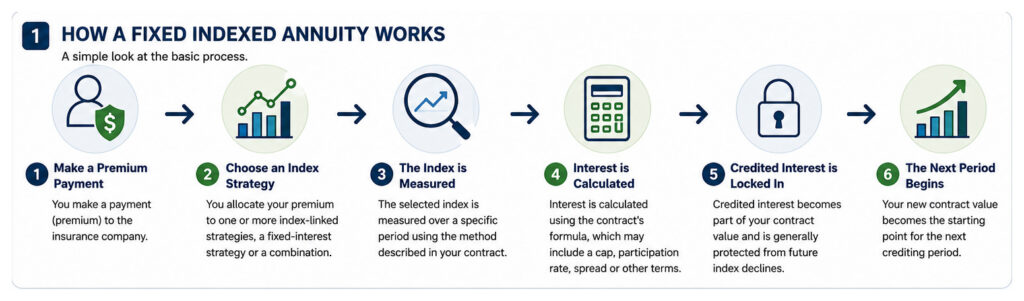
1. You purchase the annuity
You make a payment, known as a premium, to the insurance company. Some annuities accept a single premium, while others may allow multiple payments.
The amount you contribute becomes the starting value of your annuity contract, subject to the contract’s terms.
2. You select one or more interest-crediting strategies
You may be able to allocate your premium among:
- One or more index-linked crediting strategies
- A traditional fixed-interest strategy
- A combination of fixed and index-linked strategies
Common indexes include the S&P 500, Nasdaq-100, Russell 2000 and other broad or specialized market indexes. You do not own shares of the securities in the index and do not receive dividends.
3. The index is measured over a set period
The insurance company tracks the selected index using a method described in the contract.
A common method is annual point-to-point, which compares the index value at the beginning of a contract year with its value at the end. Other contracts may use monthly averaging, monthly point-to-point or multi-year measurement periods.
4. Interest is calculated under the contract’s formula
When the index rises, the annuity may receive credited interest. The interest will not necessarily equal the index’s full return because the contract may apply a cap, participation rate, spread or other limitation.
When the index falls, the indexed strategy generally receives 0% interest for that measurement period rather than a negative return.
5. Credited interest becomes part of the contract value
Once indexed interest is credited, it is generally locked into the contract value. The next crediting period begins from that new value.
The NAIC notes that an insurer uses a contractual formula to determine how an index change affects credited interest. The formula often means that the interest added to the annuity reflects only part of the index’s increase.
A simple fixed indexed annuity example
Suppose you allocate money to an annual point-to-point strategy with a 7% cap.
| Index performance for the year | Contract term | Hypothetical credited interest |
| Index rises 12% | 7% cap | 7% credited interest |
| Index rises 5% | 7% cap | 5% credited interest |
| Index remains flat | 0% floor | 0% credited interest |
| Index falls 9% | 0% floor | 0% credited interest |
In the first example, the index gained 12%, but the 7% cap limited the credited interest to 7%.
In the fourth example, the negative index return did not reduce the contract value because of the index. The contract simply received no indexed interest for that period.
This example is hypothetical and does not represent the terms, rates or performance of any particular Oceanview product. Withdrawals, surrender charges, a market value adjustment (if applicable), rider charges or other contract provisions may affect the amount available from an annuity.
How is fixed indexed annuity interest calculated?
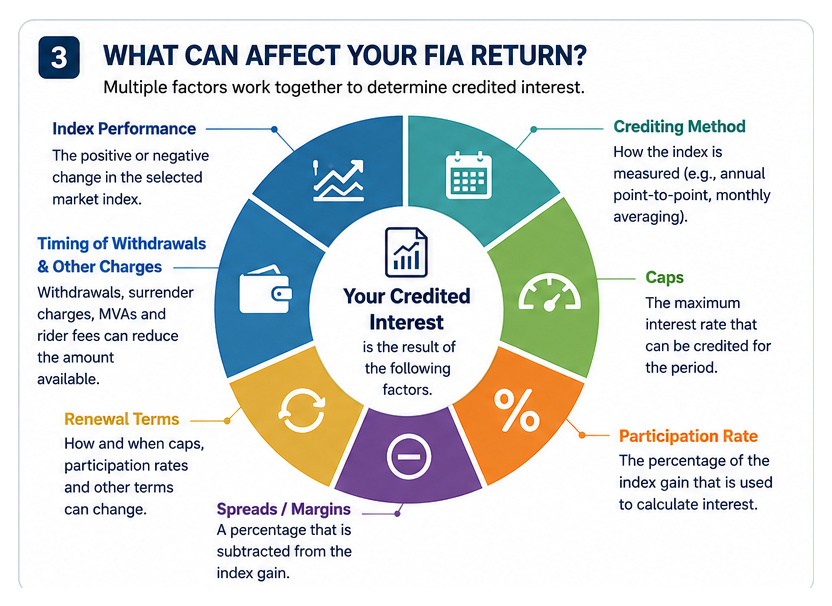
The index is only one part of the calculation. Your contract’s crediting method and renewal terms determine how much of a positive index change becomes credited interest.
Cap rate
A cap is the maximum indexed interest rate that can be credited during a measurement period.
For example, if the index increases by 10% and the strategy has a 6% cap, the contract receives 6% indexed interest.
Participation rate
A participation rate determines what percentage of the measured index gain is used in the interest calculation.
If an index rises 10% and the participation rate is 60%, the resulting credited interest would be 6%, assuming no other limitations apply. (60% x 10% = 6%)
Spread
A spread, sometimes called a margin, is subtracted from the index gain before interest is credited.
If the index rises 9% and the strategy has a 3% spread, the resulting credited interest would be 6%. (9% – 3% = 6%)
Crediting method
The crediting method determines how the index change is measured. Common methods include:
Annual point-to-point: Compares the index value on two dates one year apart.
Multi-year point-to-point: Compares the index value at the beginning and end of a period lasting longer than one year.
Monthly averaging: Uses multiple index values during the year to calculate an average.
Monthly point-to-point: Measures each month separately and combines the monthly changes according to the contract formula.
Dividends paid by companies in an index are also usually excluded when an indexed annuity’s return is calculated. Caps, participation rates, spreads, and exclusion of dividends, can further reduce the amount credited compared with the reported performance of the index.
Can crediting terms change?
Some crediting terms may be set for an initial period and then renewed periodically. The insurance company may adjust caps, participation rates, fixed rates or other non-guaranteed elements, subject to the minimums and maximums stated in the contract.
That makes it important to understand both:
- The current crediting terms
- The minimum terms guaranteed by the contract
A strong first-year rate or cap should not be evaluated in isolation, as future non-guaranteed crediting terms may differ. Ask how renewal terms are established and what the contract guarantees after the initial period.
Can a fixed indexed annuity lose money?
A fixed indexed annuity generally will not lose value solely because its selected index declines. A 0% indexed-interest floor means negative index performance normally results in no indexed interest for that measurement period, rather than a reduction in contract value due to index performance itself.
However, “protection from negative index performance” does not mean that the amount you receive can never be less than your original premium.
Your contract or surrender value may be affected by:
Surrender charges
Annuities are designed to be held for a specified period. If you withdraw more than the permitted penalty-free amount or surrender the contract during the surrender charge period, a surrender charge may apply.
A market value adjustment
Some fixed indexed annuities include a market value adjustment, or MVA. An MVA may increase or decrease the amount received from certain withdrawals based on changes in interest rates after the contract was issued.
For a deeper explanation, read Understanding Market Value Adjustment in Fixed Indexed Annuities.
Withdrawals during a crediting period
Taking money from an indexed strategy before the end of its measurement period may reduce or eliminate the interest credited on the withdrawn amount.
Rider or contract charges
Some optional benefits may have a separate charge. Those charges can reduce the contract value even when the selected index strategy has a 0% floor.
Taxes and federal tax penalties
Earnings in a nonqualified annuity generally grow tax-deferred. When money is withdrawn, the taxable portion is generally subject to ordinary income tax.
For a nonqualified annuity, the IRS generally treats a nonperiodic withdrawal as coming from earnings first and principal second. A taxable distribution taken before age 59½ may also be subject to a 10% additional federal tax unless an exception applies. Consult your own tax advisor regarding your specific situation
Insurance company risk
An annuity’s guarantees are backed by the claims-paying ability of the issuing insurance company. An annuity is not a bank deposit and is not insured by the FDIC or NCUA.
What are the potential benefits of a fixed indexed annuity?
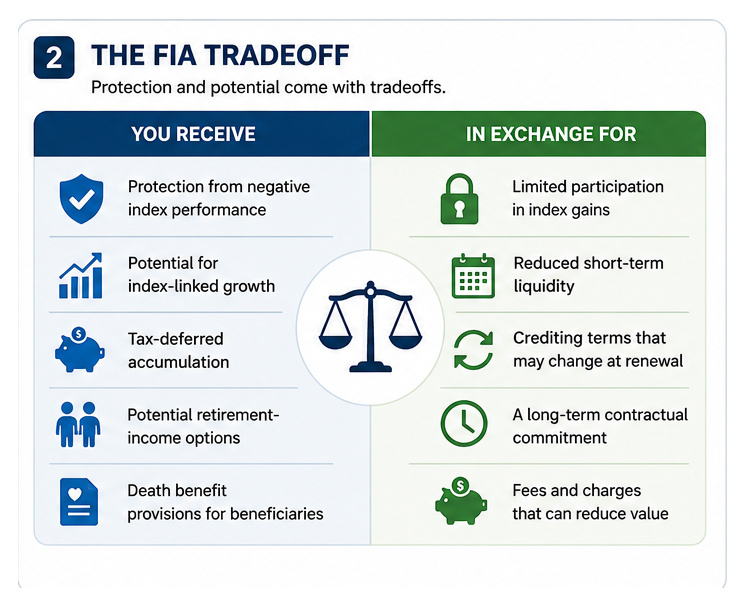
Protection from negative index performance
A FIA can provide the opportunity to earn index-linked interest without exposing the contract value to losses caused directly by a declining index.
This can be appealing to retirement savers who want less market risk but are willing to accept limits on their potential return.
Index-linked growth potential
A FIA may earn more than certain traditional fixed annuities when the selected index performs positively, and the crediting terms are favorable.
The tradeoff is that a FIA generally does not receive the index’s full return.
Tax-deferred accumulation
Taxes on earnings in a nonqualified annuity are generally deferred until money is withdrawn. This may allow interest to remain in the contract and continue earning potential interest.
Purchasing an annuity inside an IRA or another tax-qualified retirement plan does not provide additional tax deferral because the retirement account is already tax-deferred.
Protection of previously credited interest
Once interest has been credited, subsequent negative index performance generally does not take that credited interest away.
This can create a “reset” effect in which the next measurement period begins from the updated contract value.
Retirement-income options
An annuity may offer the ability to convert accumulated value into a stream of income for a set period or for life. Some contracts also offer optional lifetime-income riders, generally for an additional fee.
The details, costs and flexibility of income options vary, so they should be reviewed carefully before purchase.
Death-benefit provisions
Many annuities provide a death benefit for beneficiaries. The amount and treatment of that benefit depend on the contract terms, ownership structure, timing and applicable tax rules.
What are the limitations and tradeoffs?
A fixed indexed annuity offers protection from negative index performance by giving up some flexibility and market upside.
Your growth is limited
Caps, participation rates, spreads and the exclusion of dividends can cause a FIA to earn substantially less than the index used to determine indexed interest.
A fixed indexed annuity should not be presented or evaluated as if it were an index fund.
Your money may be less liquid
Taking significant withdrawals during the surrender period can result in charges or an MVA (if applicable). A FIA should generally be funded with money that is not needed for near-term expenses.
Returns are not known in advance
Unlike a multi-year guaranteed annuity with a stated guaranteed rate, the indexed interest earned by a FIA depends on future index performance and contract terms.
A positive year for the index does not guarantee that a particular strategy will earn the same return—or any specific return.
Renewal terms may change
Non-guaranteed caps, participation rates, spreads and fixed rates may be adjusted at the end of each crediting term. The contract’s guaranteed minimums may be significantly lower than its initial terms.
The contract may take time to understand
FIAs can include several indexes, measurement methods and interest-crediting formulas. More choices are not always better if the owner does not understand how those choices work.
Clarity matters more than complexity.
Fixed annuity vs. fixed indexed annuity vs. variable annuity
| Feature | Traditional fixed annuity | Fixed indexed annuity | Variable annuity |
| How growth is determined | Interest rate set by the insurer | Interest based partly on index performance | Performance of selected investment options |
| Directly invested in the market | No | No | Contributions are allocated to investment subaccounts |
| Potential effect of market declines | Generally, no direct effect | Negative index performance generally receives 0% indexed interest | Contract value may decline |
| Growth potential | Generally lower and more predictable | Moderate, with contract limits | Higher potential, with greater market risk |
| Are future returns known? | Rate may be known for a stated period | No | No |
| Primary tradeoff | Less growth potential | Limited upside potential and reduced liquidity during the surrender-charge period. | Exposure to market losses and contract fees |
Investor.gov describes fixed indexed annuities as offering more growth potential and risk than traditional fixed annuities, but less investment risk than registered index-linked or variable annuities.
Who might consider a fixed indexed annuity?
A FIA may be worth discussing with a licensed financial professional when you:
- Are saving for retirement or another long-term objective
- Want protection from losses caused by negative index performance
- Are comfortable receiving only part of an index’s potential gain
- Have sufficient liquid savings for emergencies and near-term expenses
- Do not expect to need substantial access to the premium during the surrender period
- Value tax deferral in a nonqualified account
- Want the option to create future retirement income
The decision should be based on your complete financial circumstances, including liquidity needs, time horizon, tax status, income goals, risk tolerance and existing retirement assets.
When might a FIA not be a good fit?
A fixed indexed annuity may be less appropriate when you:
- Expect to need the money in the next few years
- Do not have adequate emergency savings
- Want full participation in stock-market gains
- Are uncomfortable with changing renewal caps or participation rates
- Need a simple, fully guaranteed rate that is known in advance
- Do not understand how the proposed crediting strategy works
- Would have to pay significant surrender charges to move money from another product
- Are considering the annuity mainly because of an unusually high introductory rate
A FIA is one possible retirement-planning tool—not a complete retirement strategy by itself.
Questions to ask before purchasing a FIA
Before making a decision, ask the licensed professional presenting the annuity:
- How long is the surrender-charge period?
- How much can I withdraw each year without a surrender charge?
- Does the contract include a market value adjustment?
- Which crediting terms are guaranteed, and which can change?
- How is each index strategy measured?
- Are dividends included or excluded?
- What are the current cap, participation rate, or spread?
- What are the contractual minimum renewal terms?
- Could I lose credited interest if I withdraw money before the end of a crediting period?
- Are there charges for optional riders?
- What happens to the contract at death?
- What retirement-income options are available?
13. What are the insurance company’s current financial strength ratings from independent rating agencies? 14. How is the financial professional compensated?
15. Why is this annuity appropriate for my specific needs?
The NAIC encourages annuity buyers to compare products, understand current and guaranteed rates, review charges and adjustments and consider the financial strength of the issuing insurer.
A clear approach to fixed indexed annuities from Oceanview
Retirement products do not have to be explained in complicated terms.
Oceanview Life and Annuity Company is focused on simple, transparent annuity solutions that help consumers understand what their contract does, what it does not do and what to expect over time.
Oceanview’s Harbourview Fixed Indexed Annuity currently offers multiple index-crediting strategies as well as a fixed-interest strategy. Product terms, features and availability vary by state and should be reviewed in the applicable contract and disclosure documents.
Oceanview Life and Annuity Company has an A (Excellent) Financial Strength Rating from AM Best, with a stable outlook, affirmed February 11, 2026. Ratings are subject to change and are not a warranty of an insurer’s current or future ability to meet its contractual obligations.
Learn more about the Harbourview Fixed Indexed Annuity or speak with a licensed financial professional about how a FIA may fit within your broader retirement strategy.
No product recommendation is being made by this article.
Frequently asked questions
Is a fixed indexed annuity a stock-market investment?
No. A FIA is an insurance contract. Its interest may be calculated partly by reference to an index, but the contract owner does not directly own the stocks or other securities included in that index.
What happens to a FIA when the market falls?
Negative performance by the selected index generally results in 0% indexed interest for the measurement period. It generally does not reduce the contract value due solely to negative index performance. Withdrawals, surrender charges, an MVA or contract charges can still reduce the amount available.
Does a FIA receive all the gains of an index?
No. Caps, participation rates, spreads, crediting methods and the usual exclusion of dividends can cause the credited interest to be lower than the index’s reported return.
Is a fixed indexed annuity the same as an index fund?
No. An index fund invests directly in securities intended to track an index and can rise or fall with the market. A fixed indexed annuity is an insurance contract with index-linked interest, contractual limitations and insurance guarantees.
Are FIA earnings taxable?
Earnings in a nonqualified annuity generally grow tax-deferred. The taxable portion of a withdrawal is generally taxed as ordinary income. Different rules apply to qualified accounts, annuitized payments and inherited contracts, so consult a qualified tax professional about your situation.
Can I withdraw money from a fixed indexed annuity?
Generally, but the contract determines when and how much can be withdrawn without a surrender charge. An MVA may also apply to certain withdrawals. Review the free-withdrawal provision and surrender schedule before purchasing.
Is a fixed indexed annuity FDIC insured?
No. Annuities are insurance products, not bank deposits. They are not insured by the FDIC, NCUA or another federal government agency. Guarantees depend on the claims-paying ability of the issuing insurance company.
What is the main advantage of a fixed indexed annuity?
The main potential advantage is the combination of protection from negative index performance and an opportunity to earn interest linked, in part, to the performance of an external market index, subject to contract limitations.
What is the main disadvantage?
The primary tradeoff is that growth is limited, while access to the money may be restricted during the surrender period.
Disclaimers
Annuities issued by Oceanview Life and Annuity Company, 1331 17th St., Suite 1050, Denver, CO 80202. In California, doing business as Oceanview Life and Annuity Insurance Company www.oceanviewlife.com.
HARBOURVIEW ANNUITIES ARE PRODUCTS OF THE INSURANCE INDUSTRY AND NOT GUARANTEED BY ANY BANK NOR INSURED BY THE FDIC OR NCUA/NCUSIF OR ANY OTHER FEDERAL GOVERNMENTAL AGENCY. MAY LOSE VALUE. NO BANK/CREDIT UNION GUARANTEE. NOT A DEPOSIT. MAY ONLY BE OFFERED BY A LICENSED INSURANCE AGENT. GUARANTEES ARE SUBJECT TO THE CLAIM PAYING ABILITY OF THE ISSUING INSURANCE COMPANY.
Annuities are generally designed as long-term retirement solutions and have certain limitations. They are generally not intended to replace emergency funds, serve as income for day-to-day expenses, or support short-term savings goals. Please review the contract for full details.
A.M. Best Rating as of December 11, 2024, is subject to change. A (Excellent) rating is third highest of fifteen possible rating classes for financial strength. The outlook assigned to these Credit Ratings is stable.
This material is a general description intended for general public, educational use. Oceanview Life and Annuity Company is not providing investment advice for any individual or in any individual situation, and therefore nothing in this correspondence should be read as such.
Withdrawals in excess of any Free Partial Withdrawal amounts are subject to a Surrender Charge and Market Value Adjustment (MVA). The MVA may have the effect of increasing or decreasing the Surrender Value of the withdrawal depending on the market interest rate changes.
The IRS may impose a penalty for withdrawals prior to age 59 ½.
Contracts purchased in an IRA or other tax-qualified plan provide no additional tax-deferral benefit, since they are already afforded tax-deferred status. All annuity features, risks, limitations, and costs should be considered prior to purchasing an annuity within a tax-qualified retirement plan. For non-qualified annuities, tax deferral is not available to corporations and certain other entities.
While care was taken in preparing this information and it is considered reliable, contract, application, illustration, and product disclosure language should be relied upon when contrary. The Company reserves the right to correct any typographical errors that may exist.
Rates, renewal caps, and declared interest rates, will always follow contract provisions relative to minimums and maximums stated. Oceanview determines, at its discretion, the rates, renewal caps and, declared interest rates above the contractual minimums that are guaranteed.